Techno-Optimism and Sustainable Urban Development
Aylin Ismayilova, MSC Social Anthropology
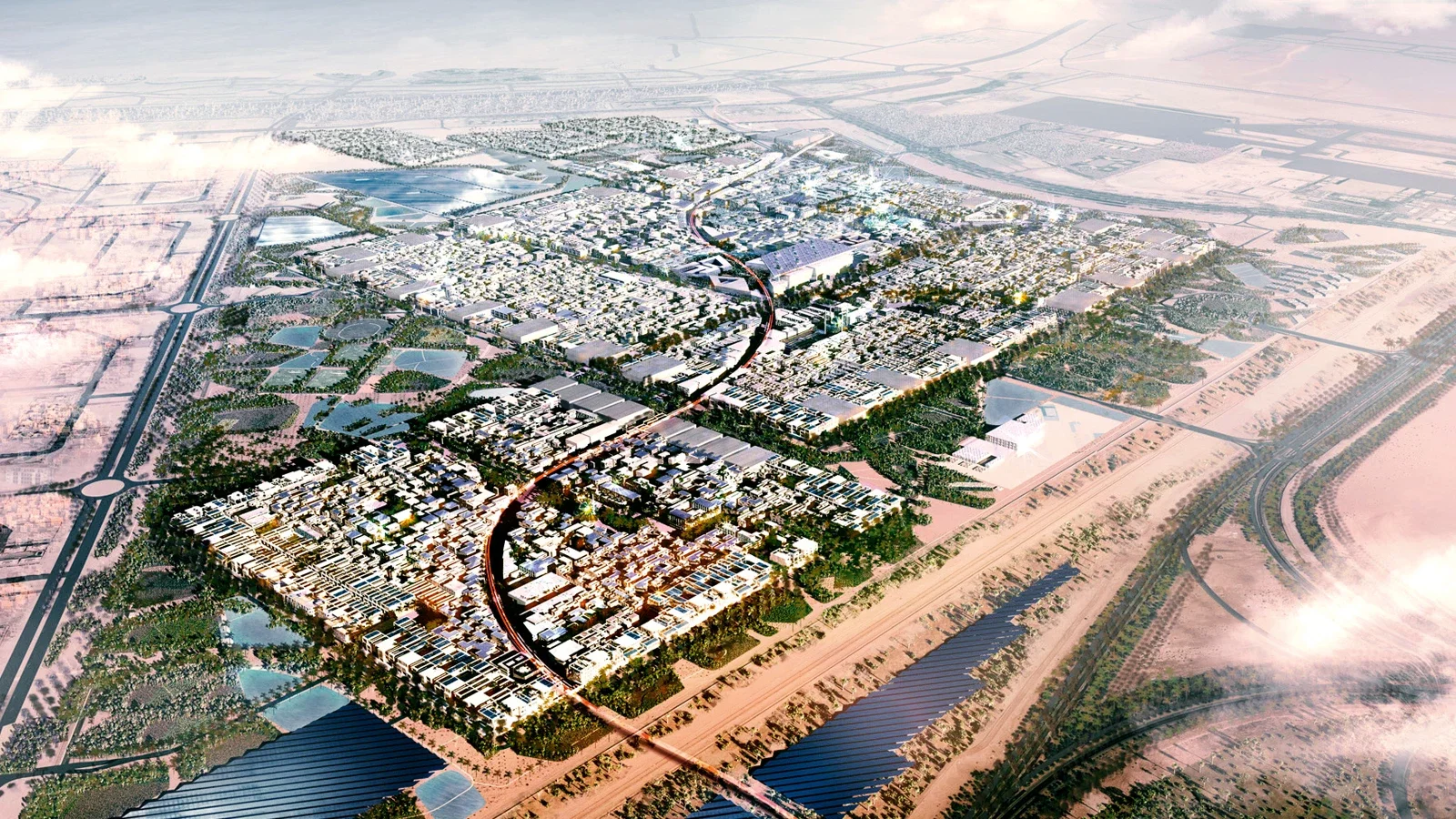
Image: Nigel Young and Roland Halbe
"Like all walls, it was ambiguous, two-faced. What was inside it and what was outside it depended upon which side you were on." - Ursula K. Le Guin, The Dispossessed
Futuristic eco-cities have been widely regarded as the leading urban model for the future. These cities are as much urban areas as they are projects that integrate technological innovation with sustainable urban life in the face of climate change. A notable example is the UAE’s Masdar City. Often described as a “spaceship in the desert,” Masdar City is imagined as a self-contained, technologically advanced enclave capable of overcoming the environmental challenges that define contemporary urbanism. Drawing largely from the ethnographic analysis presented in "Spaceship in the Desert" by Gökçe Günel (2015), this essay approaches the city not simply as a technological project but as a social and political one. Rather than representing a universal solution to ecological crisis, Masdar reflects broader dynamics of capitalist development, in which sustainability is inseparable from—and even relies on—exclusion, labour exploitation, and speculative futuristic design. By examining the city’s selective vision, reliance on migrant labour, and prioritisation of entertainment over function, this essay argues that Masdar reproduces existing inequalities while projecting an idealised—but ultimately inaccessible—image of green development.
Masdar City was planned as a self-sustaining eco-city in Abu Dhabi, described by its founders as an attempt to "rechannel consumerism through resource management" (Günel 2015, p.12) to prepare Abu Dhabi for a post-oil future. As Rajak (2020) states, these initiatives are often shaped by techno-optimism: as extractive companies can no longer ignore the climate crisis, they turn to technological innovation, promising a deus ex machina that will emerge from Research and Development laboratories and miraculously save humanity from ecological decay without forsaking fossil fuels. In the context of Masdar City, the developers of such projects apply market-oriented technological solutions to environmental challenges in urban development, which is particularly relevant for oil-dependent economies. The utopian urban community is exclusionary by definition—a "spaceship in the desert" —envisioned as an enclosed refuge from climate change, yet accessible only to a select few. Building a highly conceptual and unprecedented eco-city in the middle of the desert, within an oil-producing country reliant on immigrant labour, raises fundamental questions about who is permitted to survive in the future, under what conditions, and at whose expense. The analogy of a "spaceship" is central to this logic of separation between the interior and exterior—the spaceship is a "finite, technically sophisticated, and insular habitat" (Günel 2015, p. 42). The outside is framed as a space that should not, or even cannot, be inhabited. The spaceship, however, is selective, preserving civilisation in a highly limited form. In the context of Abu Dhabi’s highly unequal society, the juxtaposition between the workers constructing Masdar City and its utopian promise harkens back to historical labour asymmetries in the city.
Situating the enclosed eco-city further within capitalist resource extraction, the idea of a self-sustaining city is meant to address the widespread problem of resource finitude that shapes oil-dependent economies. However, contrary to the popular narrative around Masdar City as a prototype of an eco-city that will define the future, a project of this magnitude is not universally replicable due to the massive financial investment it requires. The UAE's unique political and economic conditions facilitated an experiment of this magnitude. Despite its advertising, Masdar City is not fully powered by technology—Abu Dhabi's large immigrant labour force is essential for building and maintaining the city. The workers, however, were seen as a disposable tool. As one of the engineers working on Masdar described, when dust blocked the solar panels and diminished their efficiency, a "man with a brush" would manually wipe them clean, making human labour an essential element of maintaining the city's sustainable technology. This image of the workers who enabled the construction of the project were not envisioned as its future inhabitants. As described by Heron (2023), this vision of the future, defined as "capitalist catastrophism", reproduces eco-apartheid by redefining the future as catastrophic and securing a green transition through the exploitation of oppressed and marginalised groups. In the case of Masdar, the focus was on the potential future—humanity would be saved from the consequences of its own actions through technological advancement, but the present status quo was regarded as optimal. As such, the inequalities present were reproduced in the concept of the eco-city, limiting the notion of humanity, and reproducing eco-apartheid through hierarchical selection, exclusion, and dehumanisation.
As the eco-city exists perpetually in the future, speculation defines Masdar; unstable definitions of success and failure create ambiguity around technologically ambitious projects that sustain hope and belief in sustainable development without concrete examples of such technology working as intended. As a result, people fantasise about "a future of technological complexity, just as in science fiction movies" (Günel 2015, p. 132). However, though this fantasy is comforting and idealistic, it ignores the underlying power dynamics of such projects and facilitates their further commodification and expansion as marketable ventures.
The fantasy is built on an illusion of wealth and luxury. This is evidenced through the example of PRT pods—small, automated, driverless vehicles designed to transport passengers on a controlled track system. In this sense, the pods function as an expensive toy, designed to offer a panoramic view, "just like [a] new Porsche" (Günel 2015, p. 141). Functionality is secondary—the goal is to present an image of a fun, enjoyable innovation, and sustainability came second to the "futuristic feel" (Günel 2015, p. 142). This is not exclusive to Masdar City, as the concept of lavish innovation was defined as central to the idea of an "eco-city". The PRT pods can be seen as both a success and a failure: while popular with the public, they were not capable of functioning as the city's main public transport. The system was not designed for high demand, but that is the appeal. It was the illusion of sustainability tied to exclusivity that appealed to the masses trying the pods during Masdar's development. The PRT pods, therefore, represent techno-fetishism, as their futuristic aesthetic masks underlying fragility, unreliability, and unsustainability. Do long waiting lines for transport designed to be efficient and accessible signify success through desirability or failure through inefficiency? These debates shaped the expectations and perceptions of the researchers, engineers, and visitors interacting with Masdar. The goal of the technology was now rendered ambiguous for everyone involved—from transportation to entertainment. The PRT pods, with their uncertain results, remained half-finished.
While presenting an image of an innovative and luxurious green future, they paradoxically place it "between hopefulness and anxiety" (Günel 2015, p. 154). In being continuously postponed into the future, the fantasy is both comforting and inaccessible. As Heron (2023) describes, this unstable conception of the future under capitalist development allows for its continuous reimagining, as catastrophe is framed as inescapable while proposed solutions remain challenging, or even impossible, to implement. Similarly, Mejia-Muñoz and Babidfe (2023) describe the green economy as a mechanism perpetuating capitalistic expansion. In South America, where lithium extraction framed as a "green energy source" takes place, indigenous populations are silenced, misplaced, and subjected to economic dependency. Drawing a parallel between Abu Dhabi's long-exploited immigrant labour force and the indigenous populations of Latin America, we can trace how techno-futurism and fetishism of "green" and sustainable technologies recreate historical asymmetries and inequalities in the regions where they are implemented. The inaccessibility of the eco-city is therefore twofold: the labour force involved in its construction is excluded from the possible population, and the possible population is alienated by a constant delay into the future. Despite the illusion of prioritising sustainability and innovative solutions to environmental crises, the aim is to support capitalist growth through resource extraction or labour exploitation.
To conclude, this essay has demonstrated that Masdar City ultimately reveals the limits of techno-optimist views of sustainability under capitalist development. While presented as a model for the future, its reliance on speculation, selectivity, and historically established patterns of oppression exposes the contradictions at the heart of such projects. The city’s promise of a self-sustaining, technologically advanced urban environment does not signal a deconstruction of existing systems, but rather their reconfiguration in ways that preserve inequality. As the case of the PRT pods and the broader reliance on immigrant labour demonstrates, sustainability is not achieved through technological innovation alone, but is embedded in social, political, and economic relations that remain deeply unequal. In this sense, the eco-city does not resolve the tensions of capitalist development, but instead reproduces them in new, technologically mediated forms, fuelled by techno-fetishism and illusions of a hopeful "green" urban future.
Bibliography
Günel, G. (2019). Spaceship in the desert: energy, climate change, and urban design in Abu Dhabi. Duke University Press.
Heron, K. (2023). Capitalist catastrophism and eco-apartheid. Geoforum, 153, 103874– 103874. https://doi.org/10.1016/j.geoforum.2023.103874
Mejia-Muñoz, S., & Babidge, S. (2023). Lithium extractivism: perpetuating historical asymmetries in the “Green economy.” Third World Quarterly, 44(6), 1–18. https://doi.org/10.1080/01436597.2023.2176298
Rajak, D. (2020). Waiting for a deus ex machina: “Sustainable extractives” in a 2°C world. Critique of Anthropology, 40(4), 471–489. https://doi.org/10.1177/0308275x20959419