COPs Under Siege: How Power, Policing, and Space Silence Climate Activists
Matilde Palanque, MSc Environmental Policy and Regulation
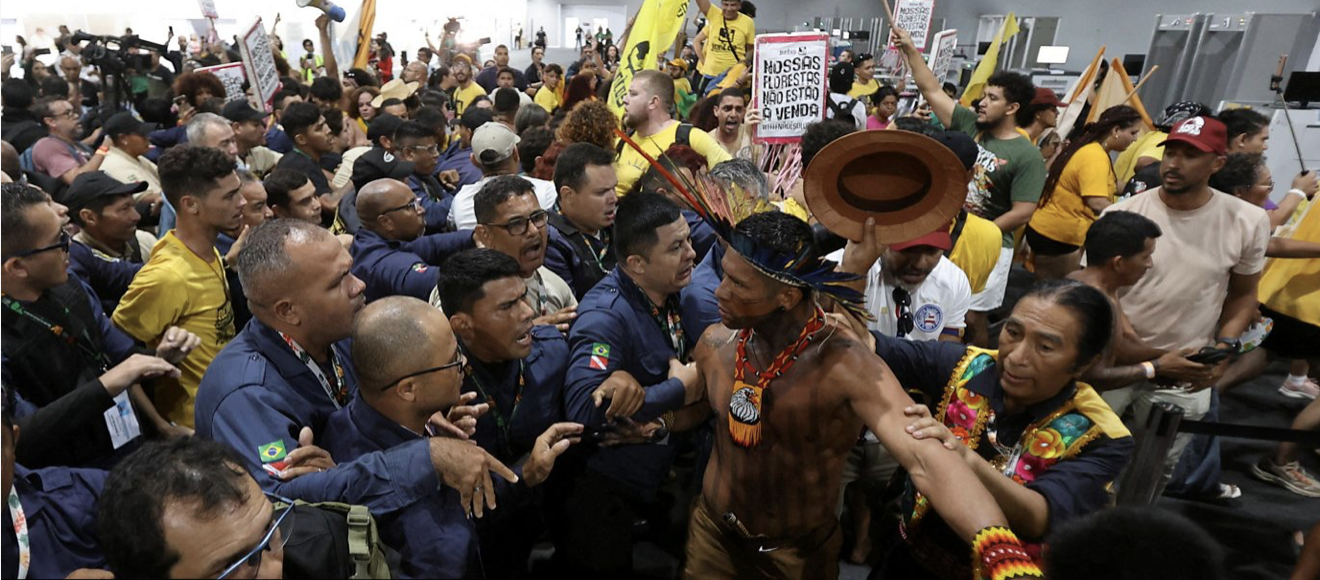
Image: Charlie Debenham / BBC News
Each year, world leaders and climate stakeholders gather under the banner of the United Nations Climate Change Conferences, the COPs, promising collective action to confront the climate crisis. However, behind the speeches, the pledges and the polished pavilions lies a critical question: is there a space for all stakeholders? And by that, I particularly refer to those adopting more confronting stances: climate activists.
Drawing from interviews with six activists who attended COPs which I conducted in Spring 2025, this article reveals how the physical and ideological organisation of these summits shape who is heard – and who is not. The analysis draws from the intersection of climate activists’ agency and the notion of space, in the physical and ideological senses. In other words, how the former is deployed in relation to the latter.
Host Nations Shape the Battlefield
The first key element shaping the deployment of climate activists is the location of COPs. Host countries do more than provide infrastructure, they set the tone of the summit through the domestic political and economic environment. This is especially salient in regard to the locations of COP27, 28, and 29, all three held in petrol states. Organising the COP, the world’s largest climate gathering, in such settings, while putting forth the phase out of fossil fuels, was qualified as a “smoke and mirror exercise”. When COPs are hosted by regimes economically reliant on fossil fuel extraction and export, tensions may arise where climate activists’ demands are perceived as threats to national economic security or political stability and thus result in the pre-emptive restriction of activist presence. The spatial presence of climate militants can be constrained by the parallel – and often dominant – presence of fossil fuel representatives and lobbyists within the same arenas.
However, even in democracies and countries that are not reliant on fossil fuels, repression is routine. At COP26 in Glasgow, in the United Kingdom – a “full democracy” according to the 2024 Economist Intelligence Unit – police surrounded protest groups, blocking access to bathrooms and inducing panic. At COP30 in Belém, in Brazil, UN security guards violently repressed Indigenous activists. Notably, they teared off Jairo Arapiun’s – chief of the Braço Grande Community in the Lower Tapajos – traditional headdress, known as 'cocar’, and hurling it backwards – a painfully symbolic gesture.
Architecture of Exclusion
The physical layout of COP venues reinforces power hierarchies. At COP28 in Dubai, in the United Arab Emirates, the venue was described as a ‘T’ shape: official negotiators at the top, country pavilions on the right, and civil society relegated to the left – with no access between sides. This categorisation of space suggests that the COP is spatially organised in a way that fosters exclusion by underlining hierarchies. The design of the spaces at COPs is not neutral but meticulously organised according to politics and interests; it reflects and reinforces existing power asymmetries between state and non-state actors following a siloed layout.
Additionally, this differentiated allocation of space hinges on the fact that different forms of activism are granted distinct levels of visibility. Not all activists were excluded from COPs’ spaces, and not all forms of activism were treated equally. The participants I interviewed belonged either to activist groups who participate in formal policy processes, or others who support formal climate negotiation processes, but without officially engaging with it and adopting disruptive stances. The first ones were often invited into official spaces and legitimised as contributors to policy dialogue. In contrast, the latter group experienced marginalisation, spatial displacement, or outright exclusion from the event.
Physically Present but Ideologically Ignored
All six respondents explicitly described how climate activists are ignored and side-lined by official negotiators. One emphasised that “politicians do not listen to activists. They are not interested, and they do not care about people screaming at them over the fence as they go in”.
Another participant also described the paradoxical situation of being, most of the time, allowed in the room to watch negotiations, meanwhile facing the lack of any form of recognition of activists’ ideas or claims. It is almost like COPs’ organisers make a vicious concession of letting climate activists in the room, to maintain the façade of progressiveness and freedom of speech. But in practice, most official stakeholders do not properly listen to militants’ demands and prevent them from disrupting the summit.
At COP30 in Belém,in Brazil, most negotiations were conducted behind closed doors with state delegations only, thereby resulting in a lack of oversight by civil society who could not observe the proceedings. What was presented as the “Indigenous COP” was yet another illustration of how non-state actors were not only excluded from negotiations, but also violently repressed.
It underlines the extent to which COPs are asymmetrically built by being discursively structured to prioritise governmental and institutional voices, leaving activists, and especially the most disruptive ones, with little to no access to the summit’s ideological space. In light of such limitations, the very conduct of COPs can be put into question.
But Activists Fight Back
In light of the tight repression and its limited usefulness on achieving climate goals, the raison d’être of COPs has been increasingly put into question. Some climate scholars and activists even reject entirely the conduct of such a summit. However, given its size and its global reputation, the event can nonetheless represent an opportunity that can be leveraged to enhance climate policymaking. The challenge now is to utilise it as a platform for change, while mitigating the detrimental impacts on climate militants and policymaking.
Indeed, what ultimately came out of the testimonies is that despite constraints, activists persist and use their agency creatively, collectively, and defiantly. At COP28, civil society formed a “human tunnel” with activists physically organising to form a narrow path, staring down ministers while holding “Keep 1.5°C alive” signs. Others turned silence into spectacle: giant puppets, finger-rubbing “noise” to circumvent bans on shouting. While this was more of a performance than an interactive moment, it certainly did elicit curiosity and awareness among participants. These embodied acts of resistance and creativity reflect what Rancière (1999) describes as making visible those “who had no business being seen” and making heard “a discourse where once there was only place for noise” (p. 30) – what the scholar conceptualises as ‘the political’. These are not just protests, they are acts of prefigurativepolitics (Žižek, 1999): refusing the spatial order of things and attempting to change the very framework that determines how things work.
Bibliography
Rancière, J. (1999). Disagreement : Politics and philosophy (J. Rose, Trad.). Univ. of Minnesota Press.
Žižek, S. (1999). The ticklish subject : The absent centre of political ontology. Verso.