Everyday and Empire: A Review of Jasleen Kaur's 'Boomerang'
Zilu Bhatt, MSC Social Anthropology and DEVELOPMENT
Jasleen Kaur’s solo exhibition ‘Boomerang’ at Hollybush Gardens demands us to think beyond the constraints of the absolute, beyond binaries. Sounds of 'Major/minor composition' play alongside two short films: one depicting a child playing a piano with their feet, and another filming a bed of daisies. The clicking switches of a lamp turning on and off in the largest room mimic the arrangements of Kaur's work, as if punctuating the corners of the exhibition itself. ‘Boomerang’ fragments itself through hyphens and traces: the after-image of empire against living in the Global North, demarcations of security and precarity, both internal and external, plurality juxtaposed against singularity -- perhaps best illuminated in Boomerang’s piece ‘Meso.’
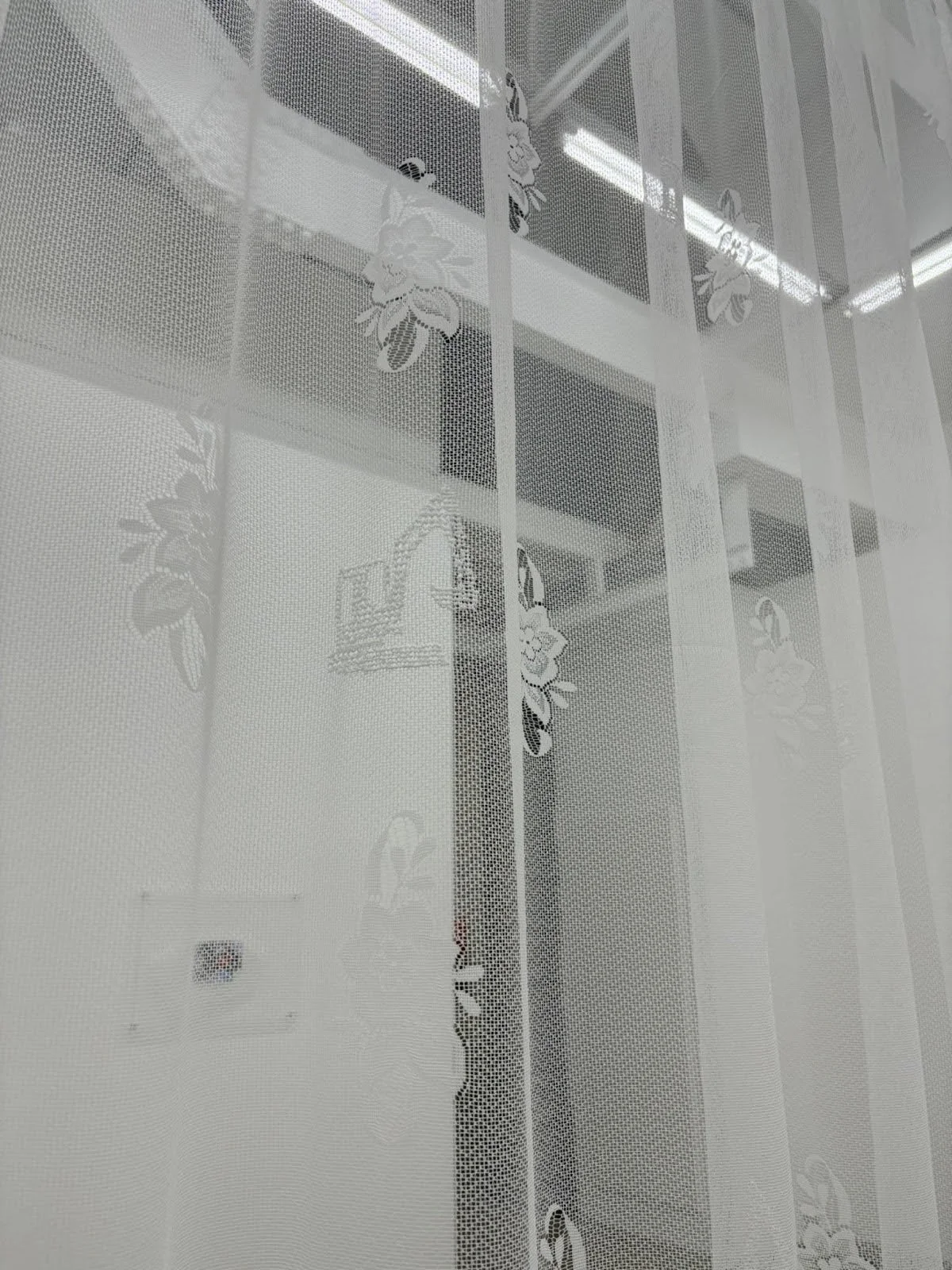
A lace curtain cleaves the room in half, classically woven with flowers that contrast against the stitchings of JCB diggers. Evoking concepts of manufacture/creation against demolition/destruction, the panel text highlights the use of JCB models against the ‘unlawful destruction of Muslim neighbourhoods in India, the demolition of Palestinian homes, and the construction of illegal settlements by Israel.’ Kaur’s visuals are striking. Lace imbues a sense of privacy – yet the material’s fragility as being so pockmarked and painfully intricate in production dislocates the idea of any possible safety within or even outside the domestic. By disjointing ideas of safety/privacy within everyday objects in immigrant and hyphenated households, Kaur introduces us to the precarity of both belonging through tangible objects but also belonging through sense and sentiment. Belongings are easily imposed and/or taken, demolished and stripped, re-packaged and redefined into varying scales of worth. What land is ours, what can be called mine?
‘Meso’s positioning as either bisection or border implies a negotiation or bargaining towards a middle ground, though Kaur’s invocation of Cesaire’s conceptual imperial boomerang is called into question. Cesaire’s claim that the ‘brutality of colonial violence “returns home”’ to the West, as the trajectory of a boomerang, disrupts the neutral safety that middle-ground negotiation can allow. The West imposes itself onto itself after devastating its colonies and peripheries. Is a middle ground the solution when the Empire’s gaze and claws are driven by extraction or, more potently, destruction? Jokic’s reading of Cesaire’s conception urges us to consider that the imperial boomerang is not solely a rhetorical move, but also a ‘literal claim about the emergence of fascism.’ Kaur's JCB diggers are representative of a violent pattern of brutality - genocide - towards Muslim populations in Palestine and India, marked by extreme border histories of partition and excavation. In tandem with this, we are reminded of the deeply concerning relations entwined with the majoritarian theocratic regimes of the occupying entities: Israel and the right-wing Hindu nationalist government of India. The latter makes up for over 30% of Israeli arms exports, as one of the largest buyers of Israeli arms. Violence is enmeshed, much like the nettings of lace, with destructive economic extractivism.
‘Small forces’, a series of photographs overlain with polythene bags and acrylic, coating the furthest walls of the largest room, turns our attention away from importations of demolition and destruction into everyday objects. Kitchen utensils, Tupperware, tin pots and iron pans, all wrapped with cellophane, evokes ideas of our consumptive waste. The imperial boomerang’s trajectory is only occupied with short-term utility, inflicting damage into our waters and land for momentary ease: off-shoring produce and production in the Global South, to be imported into the Global North, just to be discarded as landfill.
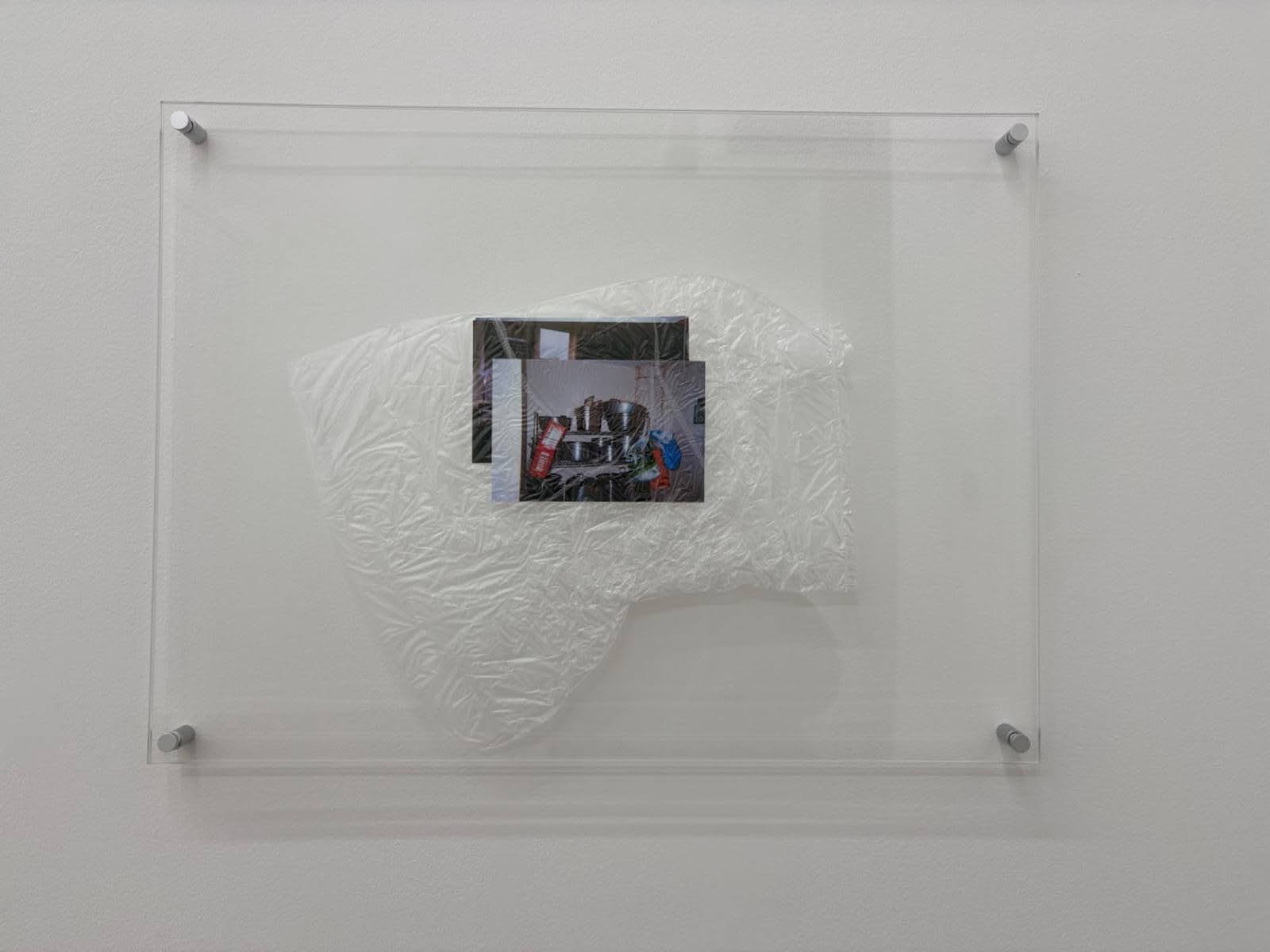
Kaur questions these epistemic productions of value in these photographs, what are our conceptions of value, and what are not? Our participation is inevitable and yet, coated with plastic under glass, are there opportunities for reconfiguring epistemic violence into protection or renewal?
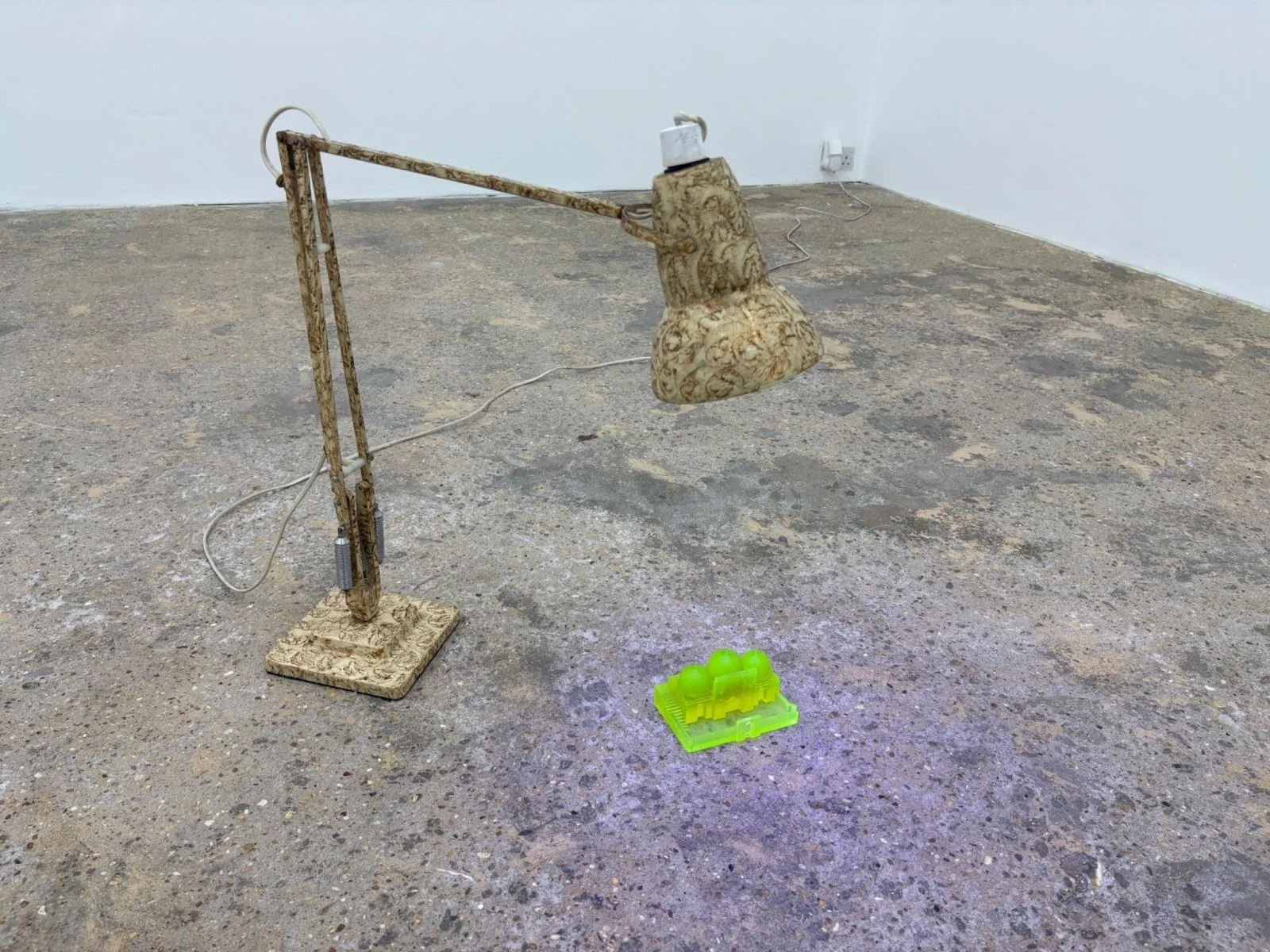
Perhaps Kaur’s most political work in ‘Boomerang’ is ‘After-image.’ Here, a uranium maquette of the Babri-Masjid is discordantly lit by the henna-ed lamp, illuminated in fluorescent greens after each click. A 16th century mosque in Ayodhya, Babri-Masjid’s demolition in 1992 confirmed what was India’s evolving majoritarian status into an almost-confirmed theocratic and nationalist regime. Heavily damaged by a mob of Hindutva supporters on the assertion that the mosque had been built on the birthplace of the deity Rama, Kaur’s cross-sensory tactic of both sound and emanating visual exemplifies the idea that hate can become both a political tool and a state project. The pendulum that swings and cements itself into right wing populism, growing and infectious through its reliance on hatred, mob mentality, scapegoating, and physical violence, concerns itself with narrative too :on re-writing, or over-writing, or deliberating asphyxiating the marginalised. Kaur’s usage of uranium mimics the toxicity of right-wing populism, slow-spreading and deliberate, but also the heavy metal’s fissioning as integral to the production of nuclear weapons. The maquette’s size hollows the dark irony of the devastating large-scale effects that extractive mining, directed by strategic state-led projects can produce when birthed from virulent and infectious hatred.
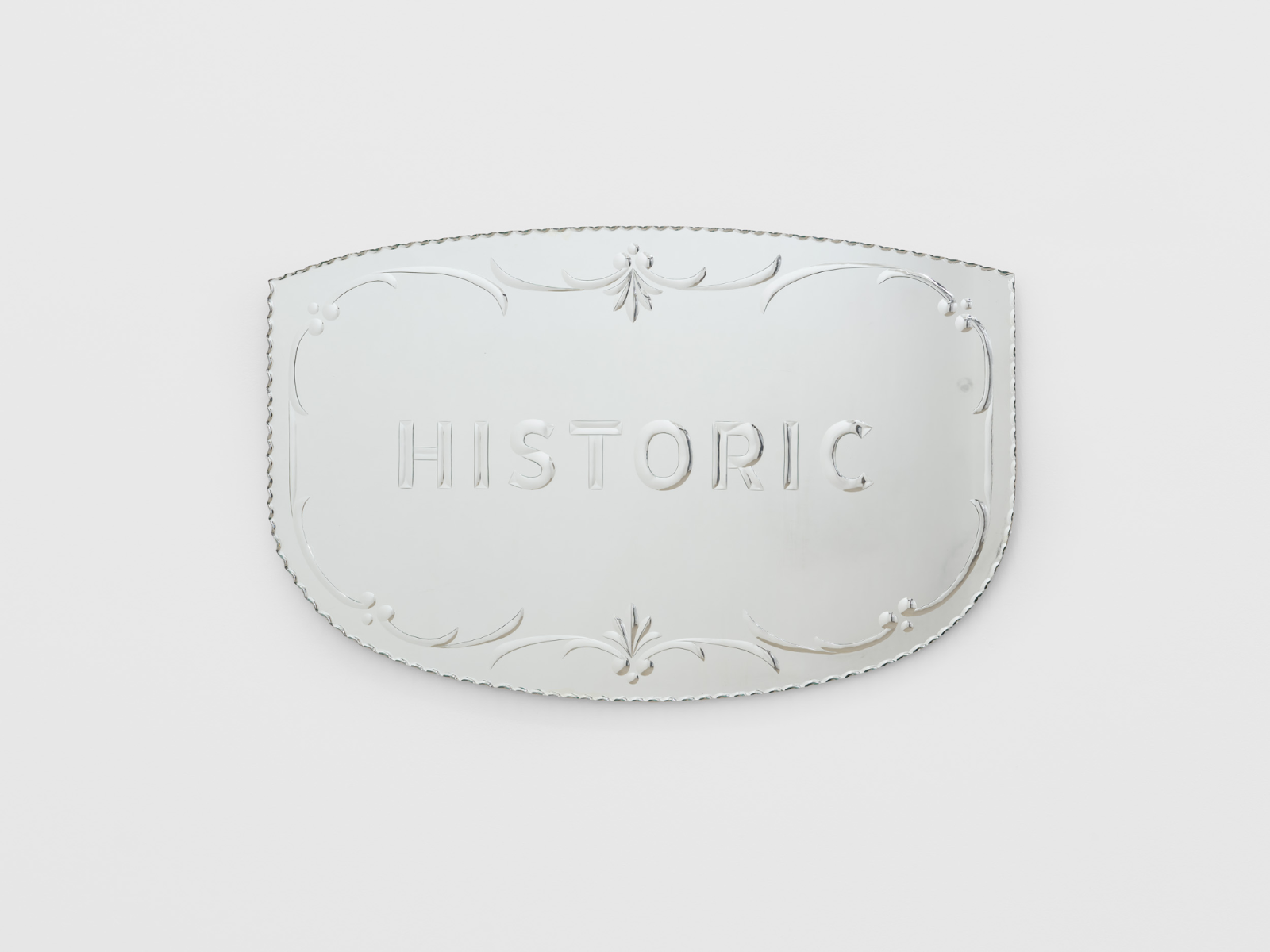
The most distinctive piece to me was Kaur’s eponymous work ‘Boomerang’: a mirror made with brilliant cut glass technique is framed in letter-cursive engravings and inscribed with the word ‘HISTORIC.’ Its positioning and size reveals your own reflection following yourself, the movement and contours of your own body as you walk throughout the room, inspecting everything else produced within it. I can only stress the ideas of value reflected into the self, and our gazes and way of seeing ruptured, we are forced to look inwards and see its own rippling effects, the fissioning of the body and mind. ‘HISTORIC’ is etched to look almost as raised welts, severing reflection, severing any conceptions we had of ourselves before, as if burning and bubbling into skin. Kaur’s website denotes her work as occupied with the “slurry of life.” This slurry churned from or into narratives of history, of empire, borders, consumption, our waste, the waste, the body – how do we see ourselves in the midst of it? How can we?